
Last updated October 16, 2026
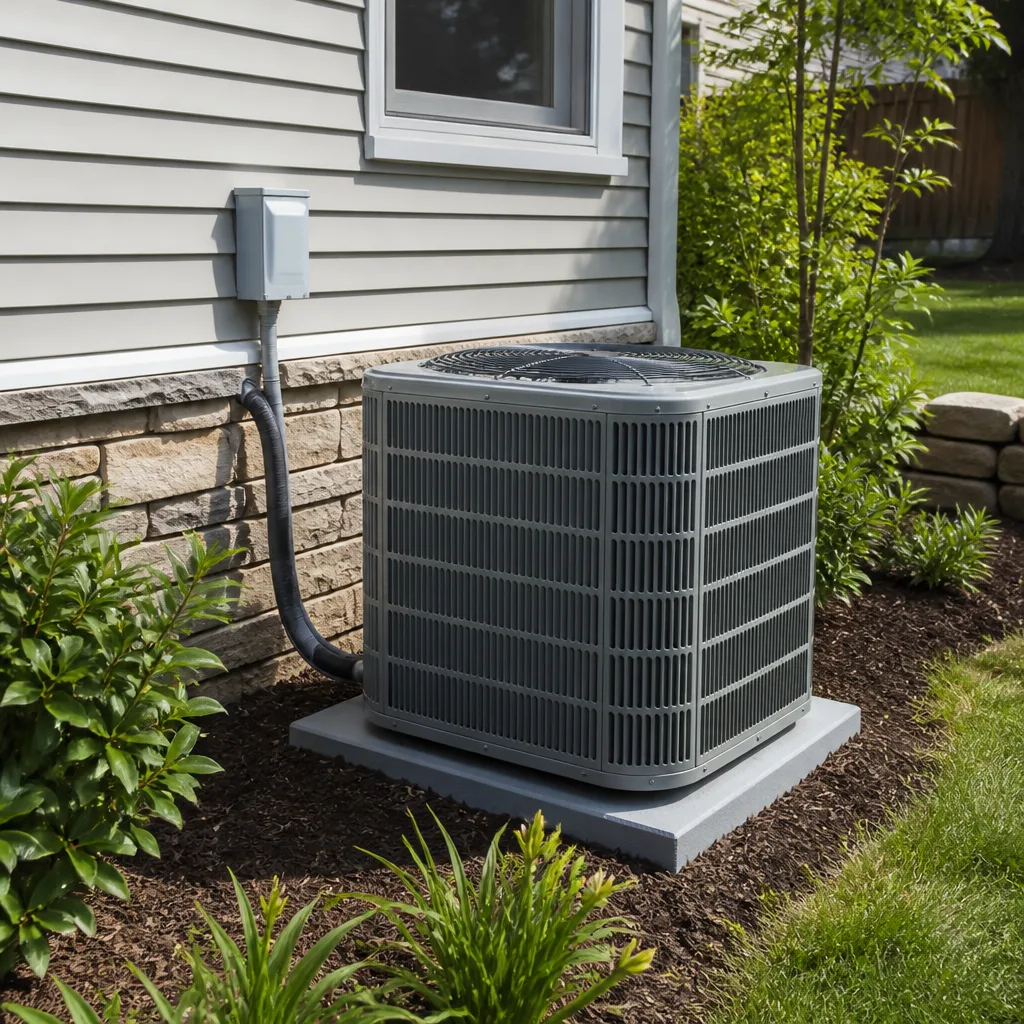 AC repair
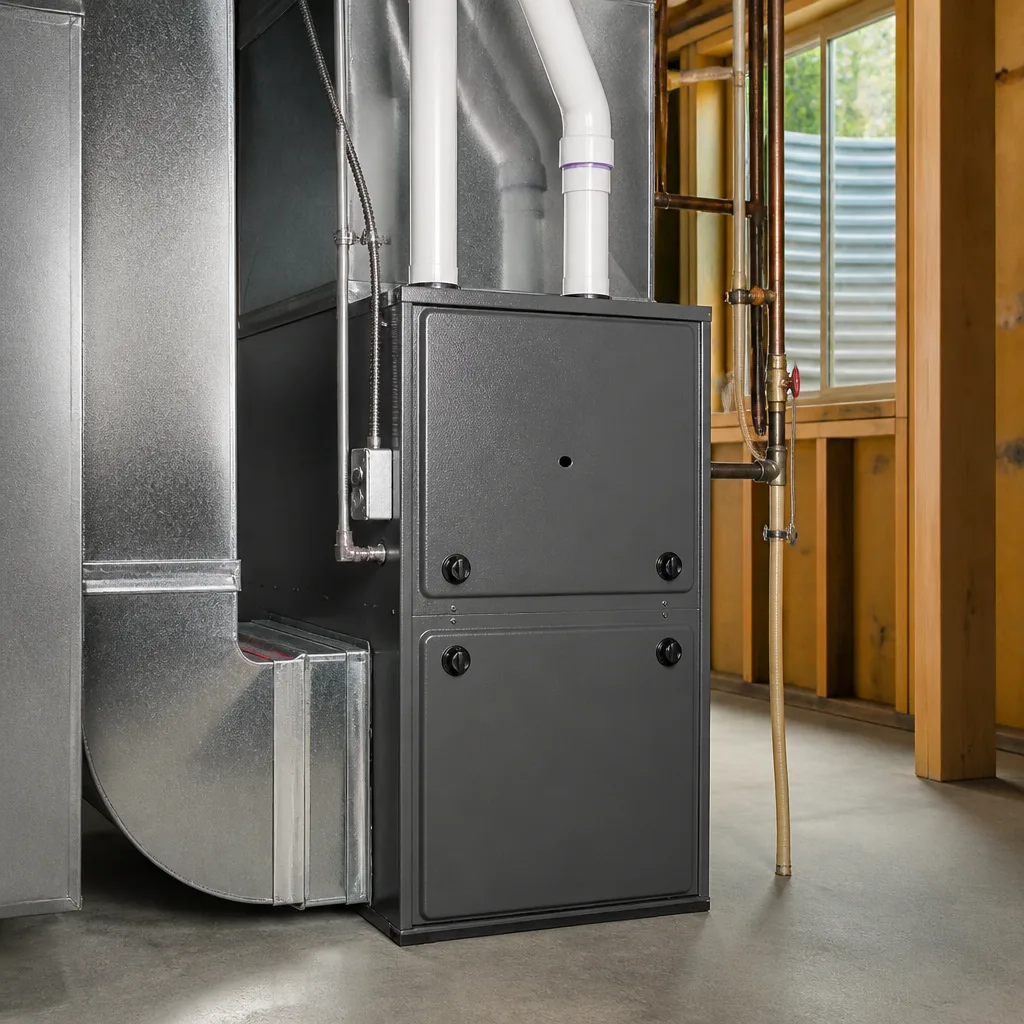 Furnace & heating
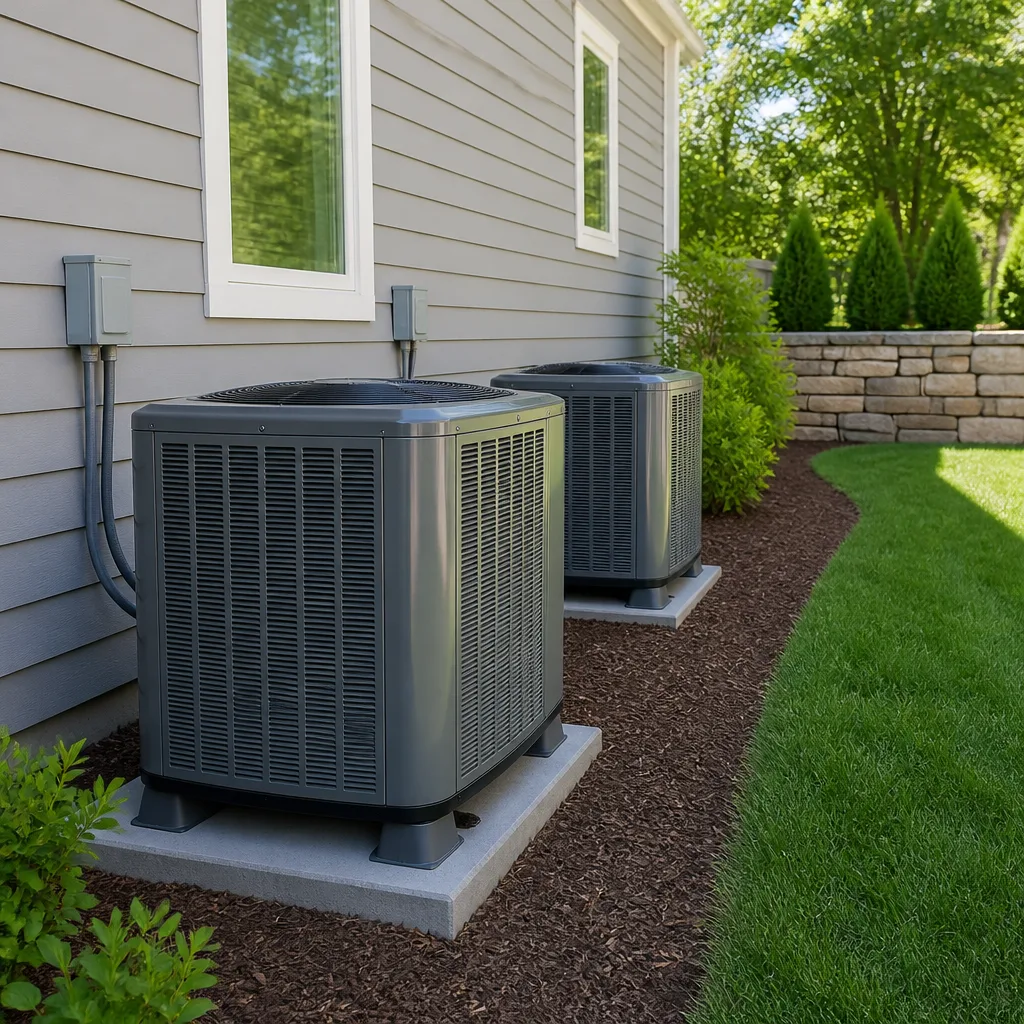 Heat pumps
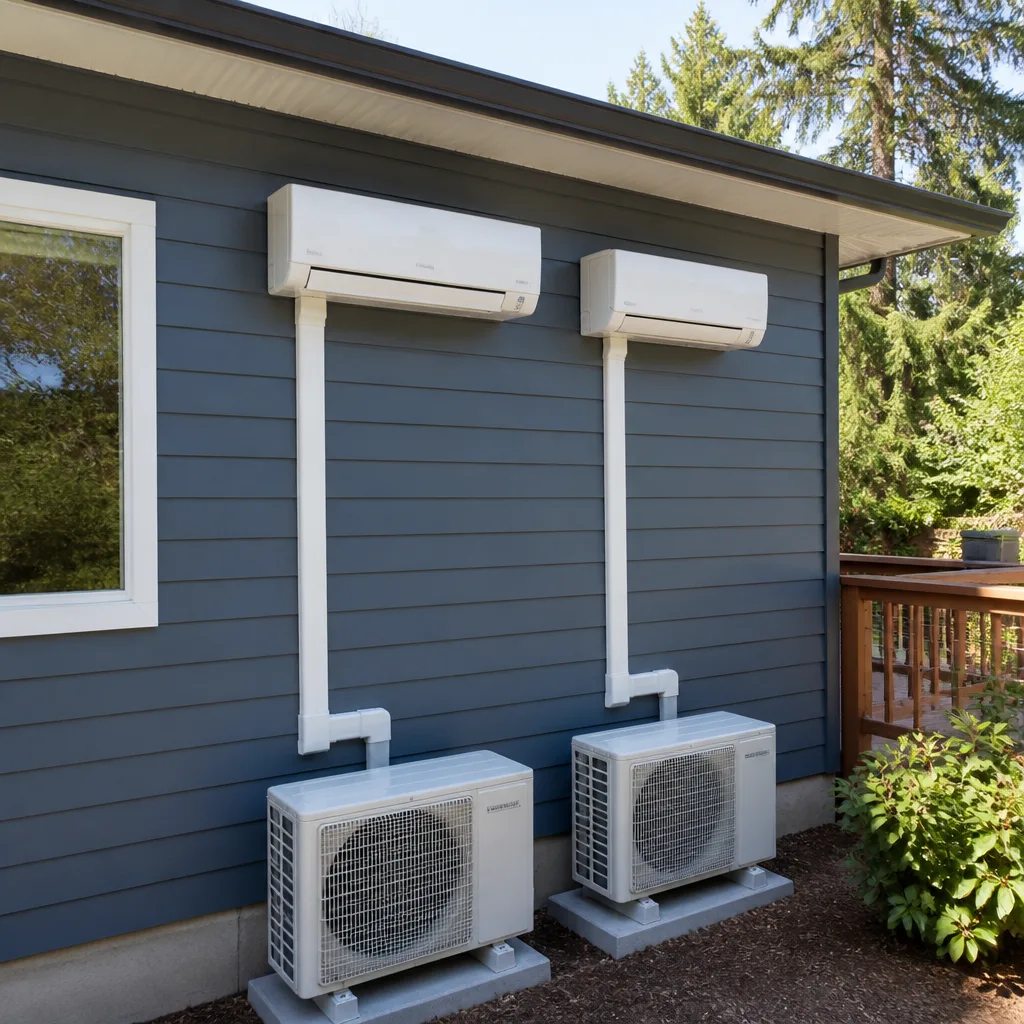 Ductless mini splits
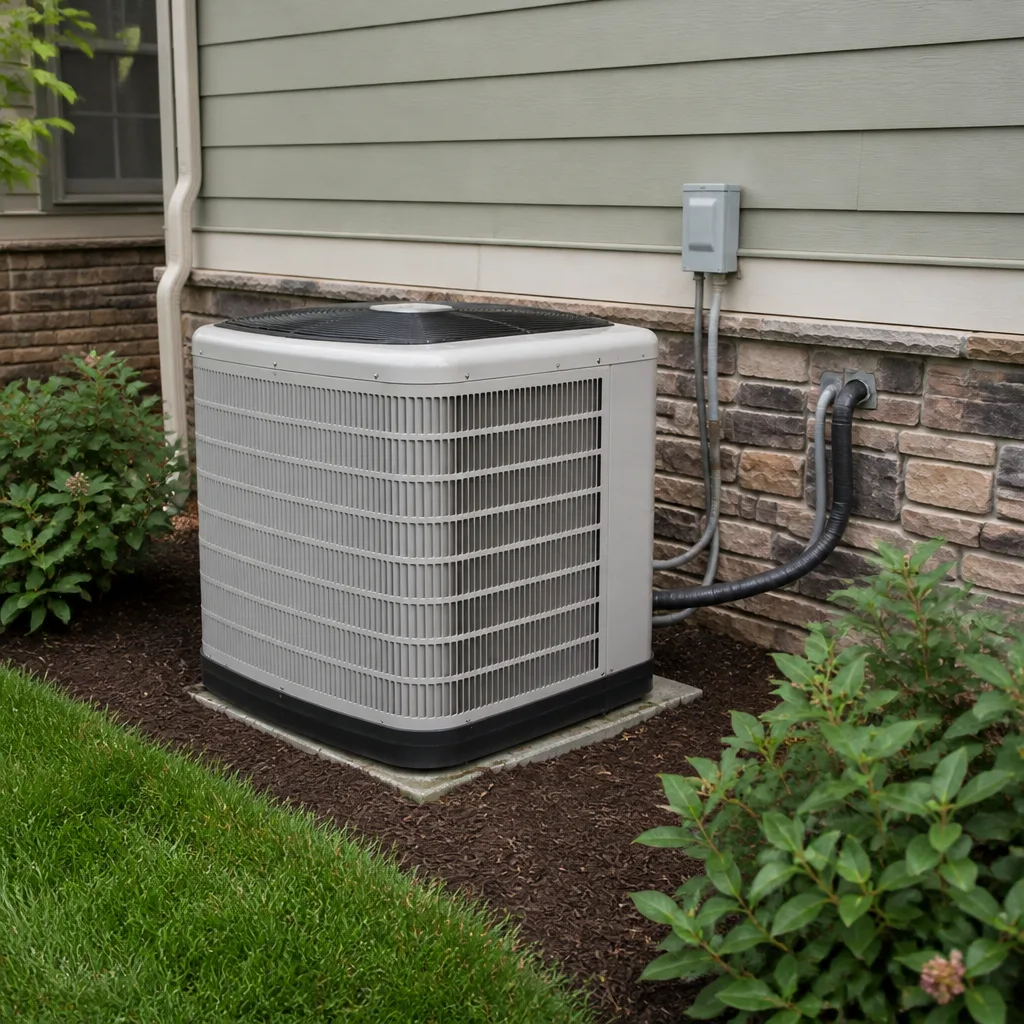 Carrier
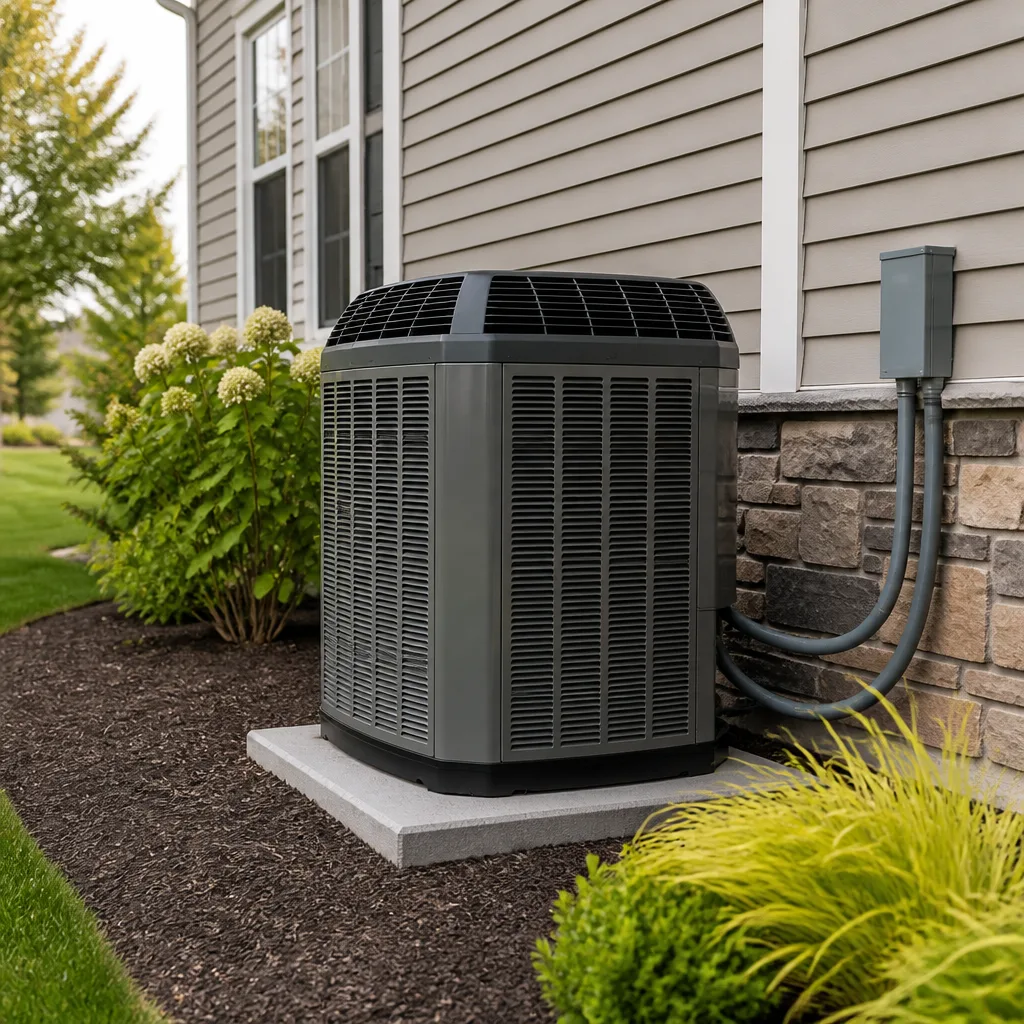 Trane
Trane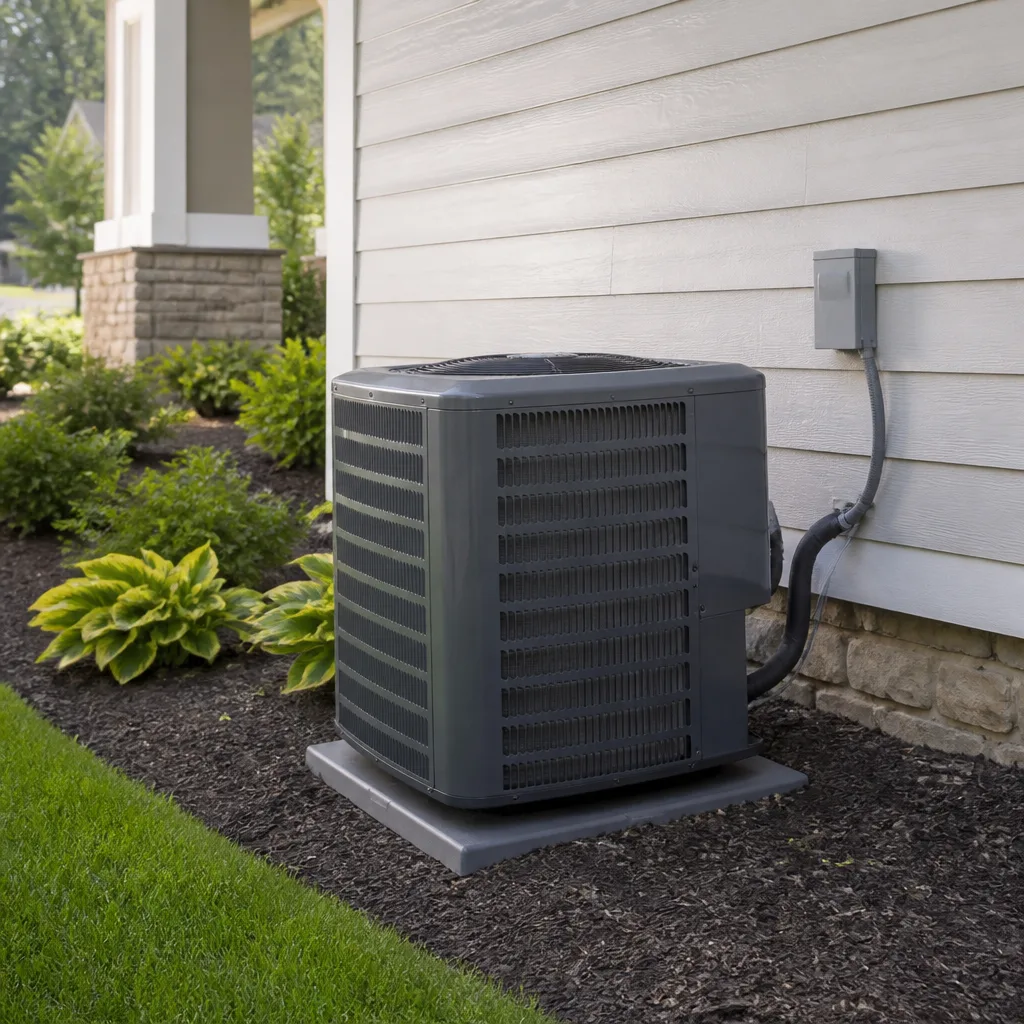 Goodman
Seasonal tune-up and full diagnostic on your Carrier, Trane, or Goodman system - readings shown to you before any repair is proposed
Diagnosis first, numbers second - you approve the repair price before a single part goes in.
Get your free estimateThe Complete Guide to HVAC in Henderson
Henderson averages 294 sunny days a year, which sounds idyllic until you understand what that actually means for your air conditioner. Those cloudless afternoons mean your outdoor unit sits under direct ultraviolet load hour after hour, season after season, while the alkaline dust that drifts in from the Mojave coats every exposed surface with a fine gray film that changes how equipment breathes. This guide is built around what Henderson’s specific climate does to HVAC equipment, not what a national average chart says should happen, though you can find more guides & resources on our blog. You’ll learn why sizing math changes when your attic hits 160°F in July, how Henderson’s hard water quietly costs you efficiency dollars every month, and what a realistic maintenance calendar looks like when seasons here don’t match the rest of the country.
Quick Answer
The right HVAC setup for a Henderson home depends on three local factors most generic guides ignore: Mojave Desert alkaline dust, summer attic temperatures that routinely exceed 150°F, and hard water averaging 278 ppm that accelerates scale buildup inside evaporator coils. A properly sized system with the correct filter strategy and a maintenance schedule tuned to Henderson’s actual season shifts will run 12 to 15 years here, while an undersized or neglected system often fails in 7 to 9. If you need a specific recommendation for your home, our team at Meadowsweet Heating and Air Henderson home provides free estimates with a written price before any work starts.
Styles & brands we work with
Table of Contents
- Henderson’s Climate and What It Does to Your HVAC System
- Alkaline Dust, Filters, and the MERV Rating Question
- Equipment Sizing: Why Henderson Math Is Different
- Hard Water and Evaporator Coils: The 278 PPM Problem
- Nationally Stocked Brands and What Five Henderson Summers Do to a Warranty
- The Month-by-Month Henderson HVAC Calendar
- Repair or Replace: The Henderson Calculation
Henderson’s Climate and What It Does to Your HVAC System
Henderson sits in the Mojave Desert’s northeastern edge, which means three things for your equipment: long stretches of triple-digit heat, very low humidity, and temperature swings that can drop 30 degrees between afternoon and night. Your cooling system runs harder and longer than units in Phoenix because Henderson’s slightly higher elevation means nights cool off a bit more, creating wider daily temperature differentials. That cycle of extreme afternoon load followed by rapid evening cooling puts more thermal stress on components than a location where temperatures stay consistently hot.
Summer highs in Henderson regularly reach 110°F to 115°F between late June and mid-August. Your air conditioner is not designed to cool your home by 40 degrees in a single cycle. It’s designed to remove heat gradually. This matters because when we arrive at homes in Green Valley or Anthem for a repair, the most common story we hear is that the system held temperature fine in May and June, then started struggling exactly when the outside temperature crossed 108°F. That’s not a coincidence. Systems that work within their design limits on a 100°F day hit their ceiling at 112°F, and any small issue that lurked undetected becomes a full failure.
Winters in Henderson are mild compared to the Northeast but damp compared to what people expect from the desert. December and January nights routinely dip into the 30s, and January is the rainy season. That moisture matters because it’s the only time of year when outdoor HVAC components see enough water to cause corrosion, especially if alkaline dust has already settled on metal surfaces and created a paste when it gets wet.
What This Means for Every Henderson Homeowner
- Your system’s hardest month is July, not August. July combines peak daytime temperatures with the longest daylight hours, so your compressor runs under direct sun for more total hours.
- Expect two stress peaks each year: the mid-July heat spike and the late-January cold front that pushes furnaces at night while daytime AC demand still lingers in sun-facing rooms.
- Dust and heat work together. Alkaline dust settles on condenser coils, and high temperatures bake it on. By August, even systems with clean May coils are running 10% to 15% less efficiently purely from accumulated grime.
- Your equipment’s useful life will be shorter than national averages if you follow a national maintenance schedule, because Henderson’s conditions are harsher than the Midwest or Southeast in ways that generic guides never quantify.
If your AC has started cycling oddly or your upstairs rooms aren’t holding temperature as summer builds, our AC Repair in Henderson services start with a full diagnostic, so you know exactly what’s happening and what it costs before any work is approved.
Alkaline Dust, Filters, and the MERV Rating Question
Mojave Desert dust is not like household dust in Ohio or Georgia. It’s fine, it’s alkaline, and it carries mineral compounds that give it a slight chemical charge. When this dust settles on an evaporator coil or blower motor, it bonds to surfaces differently than the organic dust found in humid climates. Specifically, Mojave dust clings to coil fins electrostatically and compacts into a crust when heated, which slowly chokes airflow through the coil. The result is an air conditioner that runs longer to hit the same thermostat setting while burning more electricity every cycle.
The standard advice from national guides is to use a MERV 8 filter and change it every 90 days. That advice is wrong for Henderson in two ways. First, our dust load is several times higher than the national average, which means a MERV 8 filter clogs faster here and becomes a restriction on airflow instead of a benefit. Second, the dust particles that cause the most damage in Henderson are not the large visible ones but the sub-10-micron particles that pass straight through low-rated filters and deposit directly on coil surfaces.
What MERV Rating Actually Makes Sense for Henderson Homes
- MERV 8 filters in Henderson need changing every 30 to 45 days during peak summer. That’s two to three times more often than national guidelines suggest, and it’s the frequency that keeps a MERV 8 from becoming a problem.
- MERV 11 is the sweet spot for most Henderson homes with standard equipment. It captures a meaningful share of sub-10-micron particles without creating enough restriction to strain an older or mid-efficiency blower motor. Plan to change it every 60 days, or every 45 days if you live near open desert edges like Inspirada or MacDonald Highlands where wind blows dust directly into yards.
- MERV 13 is worth considering if you have pets or allergy concerns, but only if your system’s static pressure has been checked and your blower can handle the added resistance. Modern variable-speed systems handle it well. Older single-speed blowers often cannot, and the strain shows up as premature motor failure.
- Avoid using repeated low-cost MERV 4 to 6 filters. They may look like money saved, but they let the smallest, most damaging dust particles through to the coil, which builds crust faster and costs more in coil cleaning or replacement than any filter savings.
One note for homes with dogs and cats: pet hair itself rarely makes it past the return grille into the filter, but the dander and tracked-in sand do. If you have a shedding dog, plan on checking your filter every three weeks in summer regardless of MERV rating. We always cover floors with drop cloths and wear shoe covers when entering Henderson homes during filter checks or any service call, because we know sand from kids’ play areas and pet zones migrates indoors fast.
Equipment Sizing: Why Henderson Math Is Different
Standard HVAC sizing uses a Manual J load calculation that accounts for climate, home orientation, window area, and insulation. That calculation assumes your attic behaves like a normal attic. In Henderson, that assumption fails. Between June and September, attic temperatures in older Henderson homes routinely reach 140°F to 160°F, and that heat radiates downward into living spaces at a rate the standard calculation does not fully capture. This means an undersized air conditioner in a Henderson summer has to work against heat that is not just entering through windows and walls, but descending through the ceiling in a steady, invisible load.
Undersized equipment fails faster here than almost anywhere in the country. A unit that is one half-ton too small for its Henderson load will run continuously on peak days, never reach setpoint in the afternoon, and accumulate enough compressor run time to burn out years early. The compressor is the most expensive single component to replace. When we do an AC Installation in Henderson, the site visit includes attic temperature checks during the design phase, because that number changes how much cooling capacity the home truly needs.
The Sizing Factors Most Generic Guides Miss for Henderson
- West-facing glass is brutal here. An unshaded west wall or window bank can add a full half-ton of cooling load in July. Homes on the west side of Henderson near the McCullough Range foothills get the full afternoon sun with no natural shade, which changes sizing math considerably.
- Attic temperature probes matter. If your attic hits 150°F and your ductwork runs through it, a properly sized unit can lose 20% to 30% of its cooling capacity to duct heat gain unless the ductwork is well insulated. In a 95°F attic, the same ductwork loses half as much. This is a Henderson-specific detail that changes whether you need a bigger unit or better insulation and duct sealing.
- Oversizing is a real problem in Henderson too, just differently. A unit that is too large will short-cycle, which means it cools the house quickly but does not run long enough to dehumidify or circulate air evenly. Short-cycling also causes more compressor starts per day, and every start is the highest-wear moment in a compressor’s life.
- The thermostat location matters more than in most climates. If your thermostat sits on a wall that receives direct afternoon sun in Henderson, it will read 5°F to 8°F hotter than the actual room, causing the system to overrun and waste energy. Moving a thermostat or adding a shade sensor is often a cheaper fix than replacing equipment.
- Carrier and Bryant (sister brands under the same parent company) share a design philosophy built around variable-speed compressors and sealed components that resist dust intrusion. In Henderson’s alkaline dust conditions, their sealed compressor designs have held up well, and the 10-year parts warranty applies as long as you register the unit within 90 days and schedule regular maintenance. Missing either requirement voids the full parts coverage.
- Trane and American Standard (also sister brands) are known for heavier-gauge coil construction and aluminum spine-fin coils that resist corrosion better than copper tube-and-fin designs. After five Henderson summers, the spine-fin coils on these units typically show less scale and dust buildup than competitors. The warranty structure is strong, but Trane specifically requires proof of annual maintenance for the full parts and compressor term.
- Lennox equipment tends to be efficient and quiet, with a proprietary coil design. In Henderson, Lennox units have performed well in homes with good filtration, but the brand’s tighter coil spacing means dust or scale that does accumulate requires cleaning sooner to maintain efficiency. The 10-year parts warranty and compressor coverage require registration, and Lennox dealers handle warranty claims directly.
- Goodman and Daikin (Goodman is owned by Daikin) are generally the strongest value-positioned options. Daikin in particular has built a reputation for warranty terms that out-plan competitors on paper, including 12-year parts coverage on some lines. In Henderson, Goodman and Daikin units with proper filters and coil cleaning have provided solid performance at lower upfront cost. The tradeoff is often slightly lower efficiency ratings and fewer premium comfort features.
- Rheem and York are solid mid-market brands with good parts availability in Henderson. York’s footprint in the Southwest has historically been strong, which means service parts arrive fast. Rheem’s newer coil designs have improved dust tolerance, but older Rheem units in Henderson with copper tube-and-fin coils developed the same scale and dust issues as any other brand without regular cleaning.
- January: The coldest month in Henderson, with nights in the 30s. This is when furnace issues appear. Test heat early in the month. If your furnace fails, see our Furnace Repair in Henderson guide or call for emergency service. Change your air filter. The indoor dust load in winter with windows closed is high even in the desert.
- February: The transition month. Most Henderson homeowners are not running AC or heat heavily, which makes this the ideal month for maintenance on both systems without discomfort. Our crews can work without interrupting your comfort, and the mild weather means checking the outdoor condenser is easy before dust season kicks up.
- March: Wind season starts. The Mojave’s spring winds kick up dust and sand, which will coat outdoor units quickly. Check your outdoor condenser for dust accumulation after any major wind event. A simple visual inspection catches buildup before it becomes baked-on crud in summer.
- April: First 90°F days arrive, usually in mid-to-late April. This is when you test your AC for the first time each year. Run it for 30 minutes and check that the air blowing from a register feels cool and the outdoor unit is not making unusual noise.
- May: First 100°F days. If you have not scheduled AC maintenance, do it now before the rush. Coil cleaning in May saves you the most money, because clean coils entering June mean peak efficiency exactly when electricity costs hit their seasonal floor, and you avoid paying for cooling inefficiency all summer.
- June: Heat builds toward July. Check your filter every 30 days this month. If you have west-facing windows without shade or film, consider it now because the load will only grow through July and August.
- July: Peak heat. Your AC works hardest. This is when undersized or neglected systems fail. If yours is struggling, do not wait. Emergency service calls in July are common, and a live person answers our phone 24/7, including weekends and holidays.
- August: Heat continues with more humidity than July as monsoon moisture sometimes drifts north. Dust that accumulated in March and April has now been baked and moisture-crusted. A mid-summer filter check and condensate drain check prevents the most common August failures.
- September: The second transition month. Cooling demand drops but does not stop. This is the second-best month for maintenance, especially coil cleaning after a full summer of accumulated dust and scale. Doing it now means your system enters the cooler months clean instead of crusted.
- October: First cool nights, daytime highs still in the 80s. Many Henderson homes flip between heat at night and AC in afternoon. Test your furnace now before you need it, because furnace repairs are far more comfortable to schedule in October than on a January night when the low drops below 40°F.
- November: Heating season starts gently. Daytime highs in the 60s and 70s mean furnace use picks up at night. Change your air filter and consider a basic furnace inspection if you skipped October testing.
- December: Cold nights continue, with some near-freezing lows. Your furnace will run more than any other month except January. If your heat goes out on a December night, having the compressor and filter in clean shape from the maintenance earlier in the year makes the repair faster and simpler.
- If your AC is under 8 years old and the repair is less than $800, repair is almost always the right call. Most major components are still under parts warranty if the unit was registered and maintained.
- If your AC is 8 to 12 years old and you have not kept up with coil cleaning and filter changes, the decision leans slightly toward replacement even for mid-range repairs. The scale and dust accumulation you’ve accumulated means the efficiency loss has already cost you money for years.
- If your AC is over 12 years old and the compressor or evaporator coil has failed in a Henderson summer, replacement usually beats repair. New equipment is 30% to 50% more efficient than equipment sold in the early 2010s, and that efficiency gain compounds in a climate where cooling runs eight months a year.
- If your furnace is over 15 years old and the heat exchanger is cracked or the unit is tripping safety limits, replace it. Heat exchanger cracks are the one repair that should never be patched, and the safety risk in a closed winter home is real.
We measure attic temperature and duct condition as part of our installation planning, because a written price before work means knowing what the load really is, not what a brochure says it should be.
Hard Water and Evaporator Coils: The 278 PPM Problem
Henderson’s municipal water averages 278 parts per million of dissolved minerals, mostly calcium and magnesium carbonates. That’s roughly double the national average. When air passes over your evaporator coil, it releases moisture that condenses on the coil surface. In a hard-water region, that condensed water carries trace minerals, and as it evaporates during the cooling cycle, it leaves behind a thin mineral scale. Over time, this scale builds into a crust on the coil that acts like a blanket between the cold refrigerant and the warm air passing over it.
Here’s the practical impact: even a thin, uniform scale layer of 0.5mm on an evaporator coil reduces heat transfer by 15% to 20%. In real dollars, that means a Henderson AC running with scaled coils can cost $18 to $35 more per month in electricity during summer, depending on the system size and current NV Energy rates. Over a 12-month period with eight months of cooling, that’s $144 to $280 in extra cost just from scale, not including the shortened lifespan of a compressor that runs longer every cycle to fight reduced heat transfer.
Signs that scale is building on your coil include cooling that gradually weakens over many months, higher electric bills with no change in thermostat settings, and a system that runs continuously on hot afternoons without ever quite reaching the set temperature. These are all symptoms we see in Henderson homes regularly, and the fix is not a filter change, it’s a professional coil cleaning or a check on whether your condensate drain is properly handling the mineral-laden water.
Henderson homeowners cannot realistically change the source water chemistry, but they can reduce the impact through regular coil cleaning every 3 to 5 years and by ensuring the condensate drain pan and line stay clear so mineral-laden water leaves the system instead of pooling and re-evaporating on the coil.
Nationally Stocked Brands and What Five Henderson Summers Do to a Warranty
Henderson is a major market for HVAC equipment, which means parts and units from the leading national brands are stocked locally and available without the long wait times smaller markets deal with. Meadowsweet Heating and Air Henderson services nine brands: Carrier, Trane, Lennox, Goodman, Rheem, York, Daikin, Bryant, and American Standard. That range matters because no single brand is right for every Henderson home.
Here’s the part most guides never explain: the warranty experience differs by brand after five Henderson summers. The desert does not treat all equipment equally, and understanding the differences helps you make a smarter purchase decision.
What Five Henderson Summers Mean for Each Major Brand
What we tell Henderson homeowners is that the brand matters less than three other things: correct sizing for the actual attic and window load, correct filter strategy given Henderson dust, and a maintenance schedule that does not skip coil cleaning. A properly maintained Goodman unit will outlast a neglected Trane, every time.
Because we stock parts for and service all nine brands, we’re not tied to selling you one. The conversation starts with your home’s actual measured load and your budget, and the brand decision flows from there.
The Month-by-Month Henderson HVAC Calendar
National HVAC guides tell you to schedule maintenance in spring and fall. Henderson does not have spring or fall in the way those guides assume. Our season shift dates are specific and predictable enough that a month-by-month calendar makes real sense. Here’s what we recommend for Henderson specifically.
Repair or Replace: The Henderson Calculation
The national rule of thumb says replace your HVAC system when a repair costs more than 30% of replacement value or when the system is over 15 years old. In Henderson, the numbers shift. A 12-year-old AC that has run through twelve Mojave summers has experienced a heat and dust load equivalent to 16 or 17 years of operation in a milder climate. When we evaluate a Henderson system for DIY vs Professional HVAC: The Henderson Homeowner’s Decision Guide considerations, we include that accelerated aging in the calculation.
Here’s a realistic Henderson-specific framework:
For a specific evaluation of your system’s remaining life and a written replacement price, call us for a free estimate. We’ll tell you the truth: sometimes repair is right, and we’ll say so.
Common Mistakes to Avoid
- Following national filter advice. A MERV 8 filter changed every 90 days is borderline neglect in Henderson. Our dust load demands more frequent changes, especially in summer. If you change your filter on a 90-day schedule, you are already losing efficiency by week six.
- Treating the attic as a fixed variable. If your attic hits 140°F and your ductwork runs through it, you are paying to cool the attic air around your ducts, not your living room. Duct sealing and insulation in the attic is one of the highest-return improvements in Henderson.
- Ignoring the condensate drain line. Henderson’s hard water means the drain line clogs with mineral deposits faster than in soft-water regions. A clogged drain trips a safety switch on modern equipment, and suddenly your AC will not run at all. A simple seasonal drain check prevents a July no-cool call.
- Deferring maintenance on a system that works “fine.” In Henderson, systems that work fine in May can fail in July because the marginal stress of the heat peak exposes every deferred issue at once. If you wait for symptoms, the repair is often already a breakdown.
- Choosing a unit based on brand reputation alone. Brand matters less than sizing, filter strategy, and maintenance in Henderson’s specific conditions. A cheaper brand that is correctly sized and well maintained will outperform a premium brand that is oversized and neglected.
- Not considering sun exposure when sizing. If your home has significant west-facing glass or unshaded walls, that’s load the standard sizing chart does not capture. A home in Green Valley with a shaded north orientation has a completely different load profile than the same floorplan on an exposed slope in MacDonald Highlands.
- Skipping the annual coil cleaning. Alkaline dust plus hard water equals coil crust. An annual coil cleaning in Henderson costs a fraction of the extra electricity you pay with a dirty coil, and it extends compressor life by reducing runtimes.
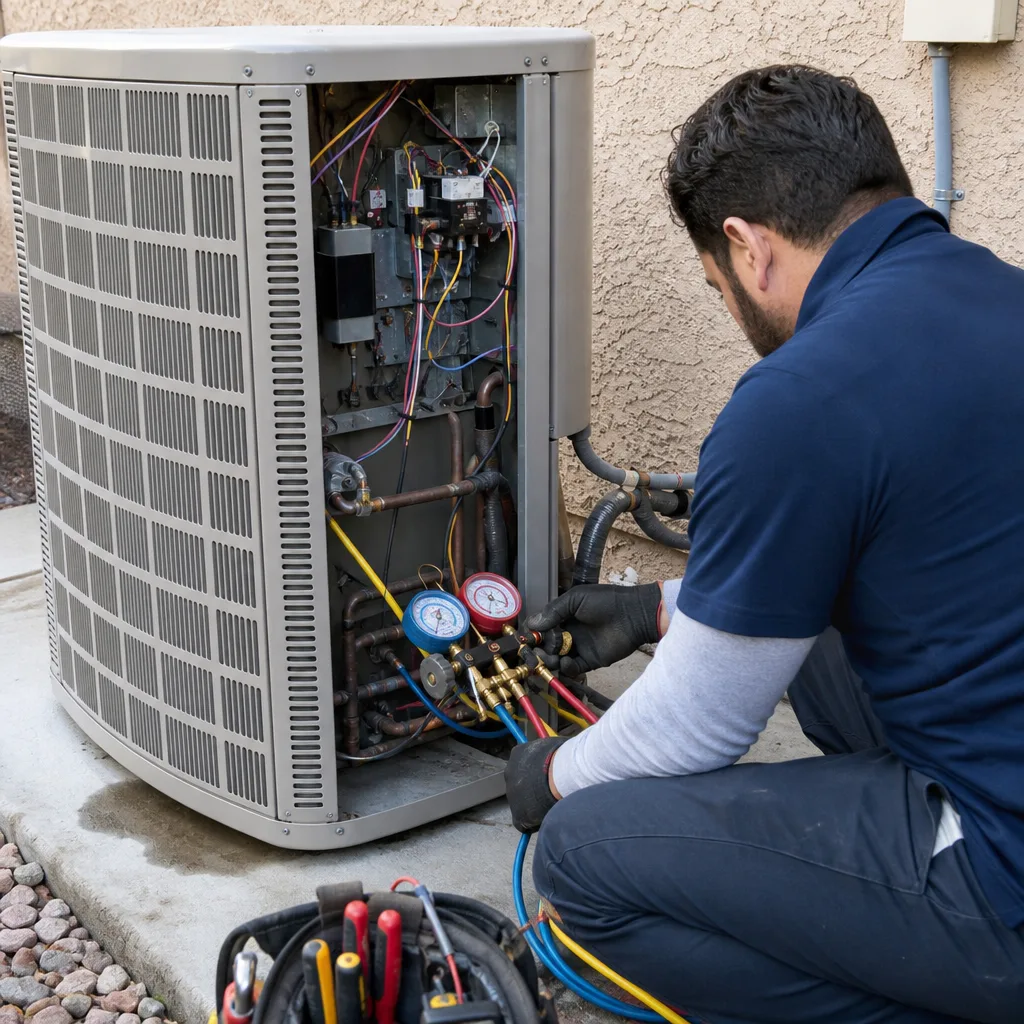
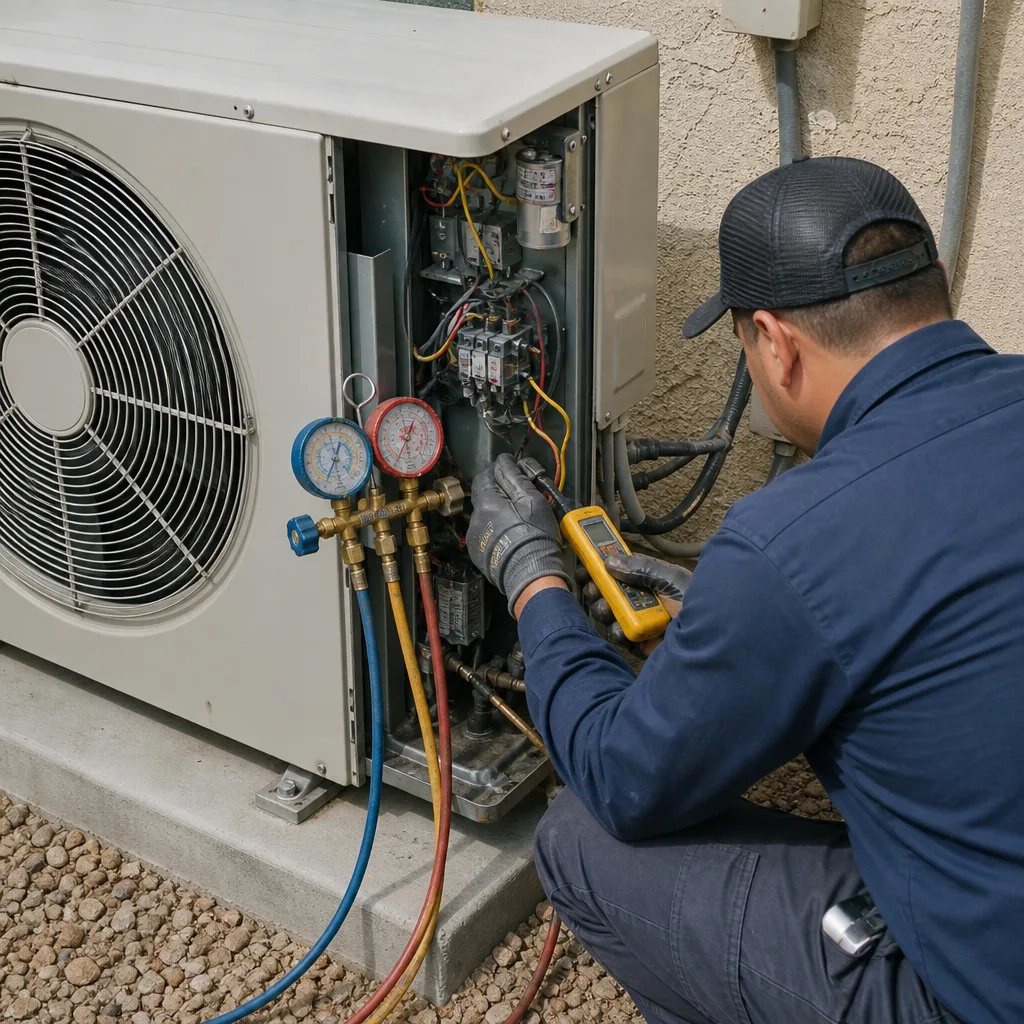
See the difference
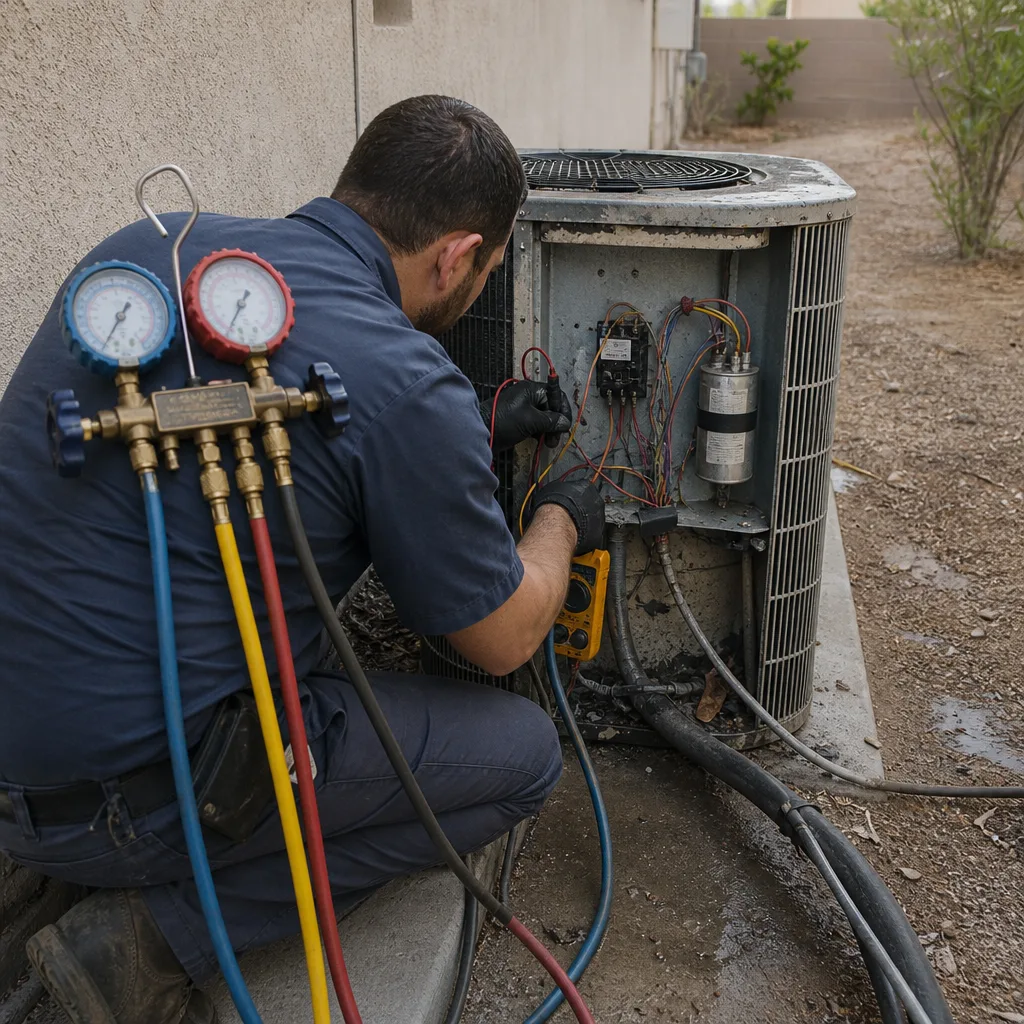 Before
 After
After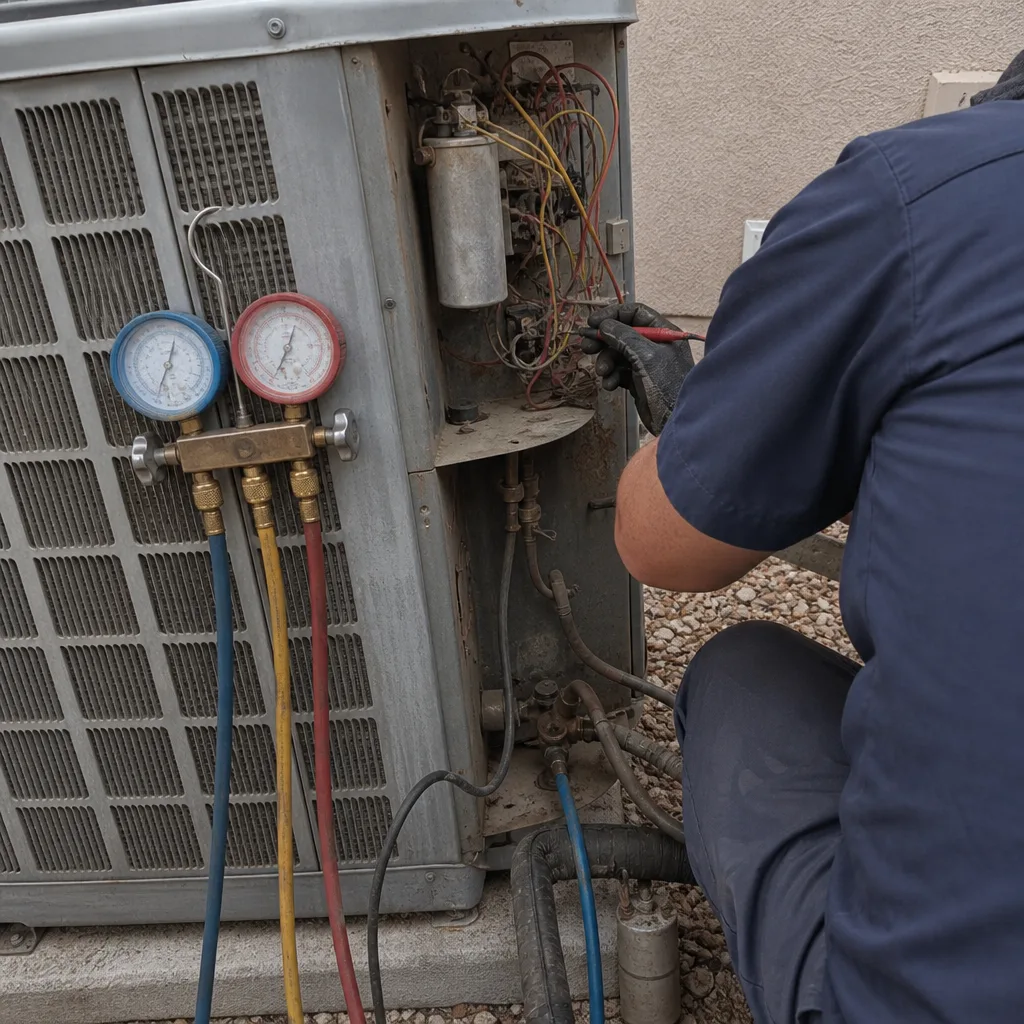 Before
 After
After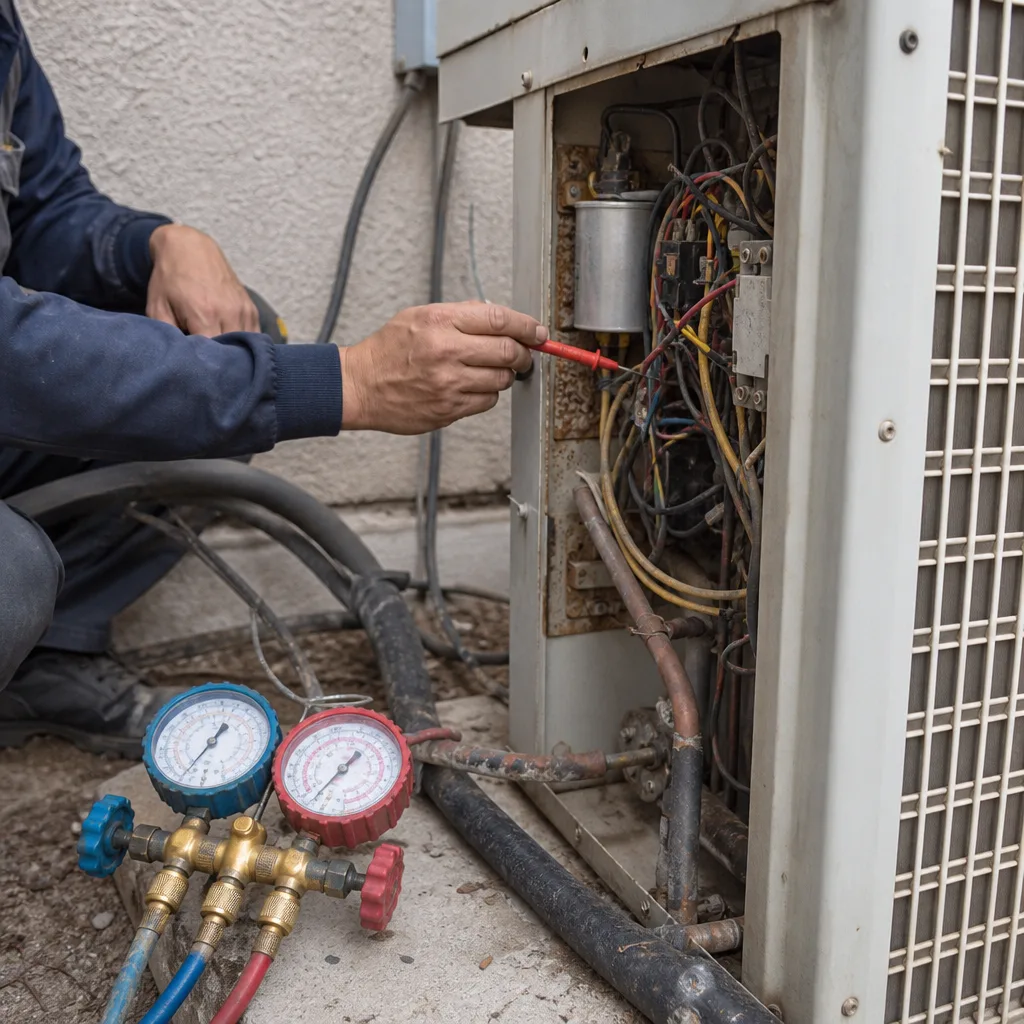 Before
 After
AfterWhen to Call a Professional
Call a professional if your AC runs continuously on hot afternoons and never reaches the set temperature, if you hear a grinding or screeching compressor, if the system short-cycles on and off every few minutes, or if your electric bill rises sharply with no change in usage; our guide on How to Hire a HVAC Contractor in Henderson: A Step-by-Step Guide can help you choose wisely. These are not normal system behavior, and in Henderson’s summer heat, a struggling system is heading toward failure. A furnace that emits any burning odor or your carbon monoxide detector sounds near your furnace, call immediately. Meadowsweet Heating and Air Henderson offers free estimates in Henderson, call (775) 257-9022, and a live person answers 24/7, nights, weekends, and holidays.
Frequently Asked Questions
A complete AC replacement in Henderson typically costs between $6,500 and $15,000 depending on system size, efficiency level, and the condition of your existing ductwork; see our HVAC Cost Breakdown: The Henderson Homeowner’s Reference for 2026 for detailed pricing factors. Mid-range 3-ton systems from brands like Goodman or Rheem generally run $7,000 to $10,000 including installation. Higher-efficiency variable-speed units from Carrier, Trane, or Daikin typically start near $11,000 and can exceed $15,000. Every installation we quote includes a written price before any work starts. Call (775) 257-9022 for an exact estimate.
In Henderson, change your filter every 30 to 60 days depending on your filter’s MERV rating, whether you have pets, and how close you live to open desert. MERV 8 filters need 30 to 45 day changes in summer. MERV 11 filters need every 60 days. If you have shedding pets or live near undeveloped land with windblown dust, plan on checking every three weeks during peak season.
If your AC is under 8 years old and the repair is under $800, repair. If it’s 8 to 12 years old with deferred maintenance, the math leans toward replacement for mid-range repairs. If it’s over 12 years old and the compressor or coil has failed during a Henderson summer, replacement usually makes more financial sense. We’ll evaluate your system honestly and give you a written repair and replacement price so you can decide with real numbers.
There’s no single best brand for Henderson. What matters more is correct sizing for the attic and sun load, a MERV 11 filter strategy, and annual coil cleaning because of alkaline dust and hard water. We service nine brands including Carrier, Trane, Lennox, Goodman, Rheem, York, Daikin, Bryant, and American Standard, and we’ll recommend based on your home’s actual measured load, not brand loyalty.
That’s a classic undersizing or reduced-capacity symptom. Either the unit was sized without accounting for your attic temperature and western sun exposure, or the evaporator coil is scaled and dust-caked from Henderson hard water and Mojave dust, reducing heat transfer by 15% to 20%. In many Henderson homes, it’s both. A diagnostic visit from us includes coil inspection and attic temperature measurement so you know the true cause before paying for any fix.
Yes, NV Energy offers seasonal rebates on qualifying high-efficiency AC units and heat pumps, typically $300 to $800 depending on the efficiency tier. Federal tax credits can add up to $2,000 for qualifying heat pump installations under current federal guidelines. We handle the paperwork and verification for your rebate, and the amount is reflected in your written price before work starts. Call (775) 257-9022 to see what your home qualifies for.
The Bottom Line
Henderson is not a normal HVAC market. The alkaline dust, the hard water averaging 278 ppm, the summer attic temperatures that break 150°F, and the long sunny-season cooling load all change how systems should be sized, filtered, and maintained. If you follow a national guide, you will undersize, under-filter, and under-maintain your system, and you’ll pay for it in July. The right approach starts with measuring your home’s actual load, choosing the right filter for Henderson dust, and keeping coils clean against our specific scale and dust combination. Get those three right and your equipment will run efficiently for years. Our team at Meadowsweet Heating and Air Henderson is ready when you are. Call (775) 257-9022 for a free estimate with a written price before any work starts.
Written by Luis Serrano, Owner at Meadowsweet Heating and Air Henderson, serving Henderson since 2004.